
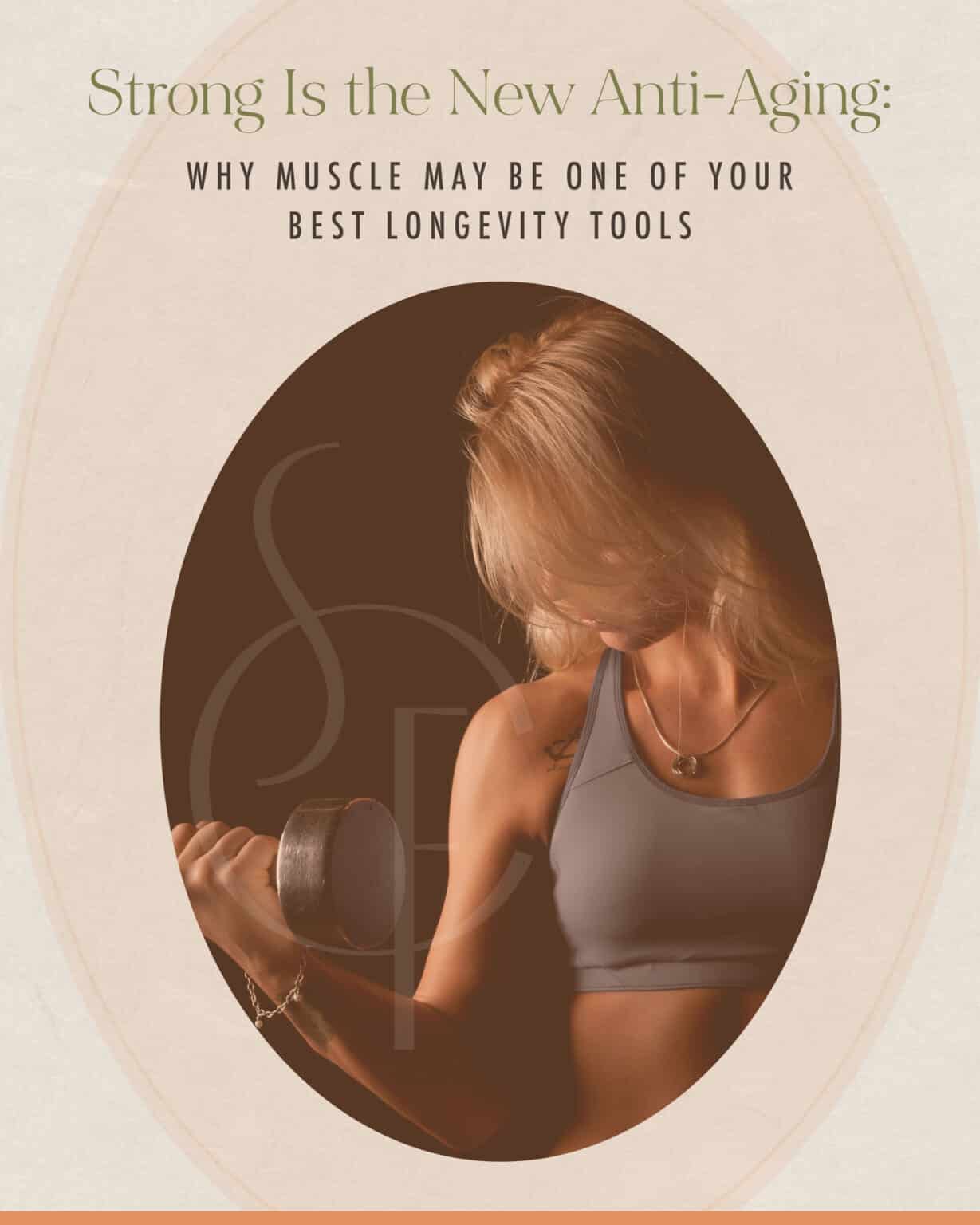
For as long as I can remember, women were told that fitness meant one thing: shrink. We spent decades obsessing over being as thin as possible, logging endless hours on the treadmill, and avoiding the weight room out of fear of getting “too bulky.”
If you’re like me, you’ve realized that mindset just doesn’t serve us anymore.
There’s a massive shift happening in the health world right now, and I could not be happier about it. The conversation is moving away from “staying thin” and toward building muscle, staying strong, and protecting our functional movement as we age. Women-specific longevity is officially one of the biggest wellness trends of 2026 — and science is finally catching up to what many of us have felt for years: our bodies need strength to thrive.
If you want to feel vibrant, energized, and capable in your 40s, 50s, and beyond, it’s time to stop trying to shrink and start building. Here’s why muscle is becoming the ultimate longevity tool for women — and exactly how I approach maintaining it.
Why Muscle Mass Changes Everything as We Age
Here’s the reality no one warned us about: starting in our 30s, we naturally begin losing muscle — roughly 3 to 8 percent per decade — and that loss accelerates with age. Once perimenopause and menopause arrive, declining estrogen speeds up muscle loss and triggers a rapid drop in bone density. Some women lose a significant share of their bone density in the handful of years around menopause. This gradual loss of muscle even has a name — sarcopenia — and it’s one of the biggest, most preventable threats to how we age.
Focusing on muscle after 40 and 50 isn’t about vanity. It’s about staying resilient, energetic, and independent. Muscle is essentially an organ of longevity:
It supports your metabolism. Muscle is metabolically active tissue — the more lean muscle you carry, the higher your baseline calorie burn, and the better your body manages blood sugar. Muscle acts like a sponge for glucose, which helps keep your energy stable and lowers your long-term risk of insulin resistance.
It protects your bones. Bone is living tissue that responds to load. Every time you lift, push, or pull against resistance, you send your body a signal to lay down new bone — one of the most powerful, drug-free tools we have against osteoporosis and the fractures that derail so many women’s later years.
It keeps you mobile and steady. Muscle protects your joints, improves your posture, and — critically — keeps your balance sharp. Falls are one of the single biggest threats to independence as we age, and strength is your best insurance against them.
It may literally help you live longer. Research consistently links strength (even something as simple as grip strength) to lower all-cause mortality. Strong women don’t just live better — they tend to live longer.
The Heavy-Lifting Trend — And Why It’s Only Half the Story
If you’ve been anywhere near fitness content lately, you’ve seen it: women are finally picking up heavy weights, and the “lift heavy” movement is everywhere. I love this. For years we were sold pink 3-pound dumbbells and endless cardio, when what our bodies were begging for was real, progressive resistance. Lifting heavier over time — what trainers call progressive overload — is one of the most effective ways to build the muscle and bone density that protect us as we age.
But here’s the nuance I don’t hear talked about enough: heavy lifting alone isn’t the whole picture. Barbell work is fantastic for building maximal strength and loading your bones, but it can be tough on aging joints, intimidating to start, and it doesn’t do much for the stability, control, and mobility that keep you moving well day to day. Max strength without control is how people get hurt.
The women who age the strongest aren’t choosing between lifting heavy or doing Pilates. They’re doing both — and letting each cover the other’s gaps.
Why I Mix Heavy Lifting AND Pilates
This is the approach I’ve built my whole philosophy around, and it’s exactly why I love what we do at BODYROK.
Heavy lifting builds peak strength and loads your bones. Resistance-based Pilates builds the control, core stability, joint integrity, and time-under-tension that make that strength usable — and keep you injury-free enough to keep showing up. Together, they’re a complete longevity program.
While traditional Pilates is wonderful for core control and flexibility, our version at BODYROK ramps up the resistance until it becomes true strength training. Using weighted springs, slow and controlled movements, and keeping your muscles under constant tension, you get real muscle-building stimulus — the eccentric, time-under-tension work that builds and protects muscle — without pounding your joints. It’s low-impact and high-reward: the perfect complement to your heavier lifting days, and a strength workout in its own right on the days your body needs something gentler.
So if you take one thing from this: don’t think of it as lifting versus Pilates. Think resistance, in as many joint-friendly forms as you can sustain for the next 30 years.
How to Build & Preserve Muscle for Longevity
Building muscle isn’t just showing up for a workout — it’s a full-spectrum lifestyle. Here are the core pillars I prioritize to stay strong without burning out.
Smart, progressive resistance training. Cardio is wonderful for your heart, but it won’t give your muscles the stimulus they need to grow. To actually build strength, you have to challenge your muscles against resistance — and gradually increase that challenge over time. Aim for resistance work 2 to 4 times a week, mixing heavier lifting with resistance-based sessions like BODYROK, and focus on movements that work multiple muscles at once.
Protein at every meal. You can’t build a strong house without raw materials. As we age, our bodies actually become less efficient at using protein, so we need more of it to get the same muscle-repair benefit. I aim for a solid dose of high-quality protein — many experts suggest somewhere around 25 to 40 grams per meal — spread across the day rather than crammed into dinner. It keeps my energy steady and gives my body what it needs to rebuild.
Recovery and sleep. Hard workouts only “work” if you let your body recover from them. A huge amount of muscle repair happens while you sleep, so I protect my 7 to 9 hours fiercely, manage my stress, and take real rest days. Chronically high stress and overtraining actually break muscle down — the exact opposite of what we want. Rest isn’t the reward for the work; it’s part of the work.
Low-impact, high-intensity movement. You don’t have to throw around heavy barbells every day to build real strength. I’m a huge believer in joint-protective strength work — the kind you can sustain for decades — which is exactly where resistance Pilates shines and why it anchors my week.
Shift Your Mindset: From “Burning Off” to “Building Up”
The best part of focusing on muscle and longevity is how empowering it feels. Working out stops being punishment for what you ate and becomes an investment in your future self.
When you prioritize strength as a woman, you’re not just training for today — you’re training for the woman you want to be 20 and 30 years from now. You’re building the capacity to carry your own bags, travel comfortably, get down on the floor and back up to play with future grandkids, and live entirely on your own terms.
Strong truly is the new anti-aging. It’s not about perfection or looking a certain way — it’s about giving your body the fuel, resistance, and recovery it needs to age with grace, power, and confidence.
As always, this is what works for me, not medical advice — check with your doctor before starting a new strength program, especially if you’re navigating perimenopause or menopause, where the right plan (and sometimes support like HRT) is worth a real conversation.
